
By Donna Westfall – January 31, 2018
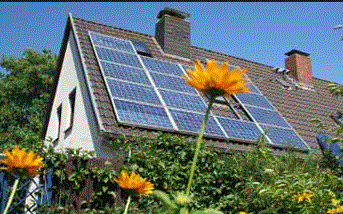 In Part 1, we’ll talk about what led up to Paul Senyszyn’s solar power installation.
In Part 2, we’ll talk about the installation process.
Finally, in Part 3, we’ll talk about how the finances worked out, and details around the performance of the system after its been in service for several months.
Paul answers two basic questions:
1) Why did you look into “going solar”?
2) How did you choose a solar power provider?
Let’s start with question #1:
“I work for the school district as the Energy Technician looking for ways to help the schools save on energy, and pointing that out to the maintenance and administration.”
Further Paul said, “I try to apply the same methods to improving efficiency in my daily life. After performing all of the possible energy efficiency upgrades to my home, the only next step was to put a solar system on my house.”
Have you always been interested in going solar?
“Actually, since I was a teenager in high school. I urged my parents to consider it for decades without any success. I wanted to go solar for many years also, but was misinformed about how easy it can be. What I mean by that is that I was always told that I would have to pay for the entire system up-front. And that system of the size needed would be outside of budget constraints, if I had to pay up-front. I think that’s what most people think, that they aren’t aware of financing options that fit their budget and make perfect sense.”
What changed?
” A friend came to visit last spring and told me about a program which provides zero out-of-pocket solar financing. Additionally, after looking into the low financing it still made sense on my small budget.”
“By using the zero-down up front and extremely low cost of financing (3.99%) through a company called “Mosaic,” all that was required of me was a good credit rating.”
“I spent a great deal of my time improving the efficiency in my home which used to use close to $200/month in electricity. I got it down to a more reasonable cost of only $95/month. My research indicated that even with an electric bill averaging only about $95 per month, my payments for a fully installed and warrantied system are just about that. In twelve years, once the payments are complete, I will own my system which will generate energy every day and well into the future. As a family man and someone thinking about the future for my children, currently 11 and 9 years old, going solar made perfect sense to me.”
2) How did you choose a solar power provider?
“The first program I learned about, Powur, boasts their ability to weed out the bad guys by vetting providers based on a number of strict factors. Each provider must offer zero down financing and meet other criteria suggesting the likelihood they’ll be in business to honor their warranties. The goal is to increase the likelihood of a good customer experience. Other factors include warranties (no less than 25 years), licenses, quality customer service, and more.”
“Powur pointed me to three different companies: one out of Murrieta (south of LA), and another from the Bay area. The closest was Westhaven Solar, based in Yuba City, with a satellite office in Blue Lake, CA, just a short drive away.”
Paul said, “I gave all three a chance to prove their willingness to travel to Crescent City to upgrade my home to solar. The decision was easy after researching three companies, who met all of my requirements.”
“The final decision resulted in choosing Westhaven Solar.”
“When it came to actually getting a firm quote, only one of the companies was actually willing to send out a salesman and install a system.”
“As it turned out, the owner of Westhaven Solar and I made an instant connection and I soon learned that we not only attended and graduated Humboldt State University, but we happened to be there at the same time, and yet never connected, as I was in the biology program, and he was in environmental science and the renewable energy program.”
“Mark Schaeffer, CEO and founder of Westhaven, explained also that the other company from southern California, had oversized my system to account for weather. Mark explained that the cooler temperatures make the system so efficient during production, that the other company would have built a system far larger than what was necessary to zero out my electrical use. He went on to say that this is a common misconception in the industry that cloudy rainy weather along the coast, and the persistent cool temperatures require over-sizing a system. Mark explained that the cool temperatures that we get in Crescent City are perfect for taking advantage of the high efficiency of the panels.”
Thank you, Paul, for allowing us to come on this journey with you. I can’t wait to learn more about solar working in Crescent City/Del Norte County.




Leave a Reply